
Floyd County Arrest Records and Charges
Floyd County arrest records begin on the law-enforcement side. The arresting agency may be the Floyd County Sheriff's Office, a city police department, Kentucky State Police, or another agency. If the person is booked into local custody, Floyd County users are routed to Big Sandy Regional Detention Center and its JailTracker roster. Booking information can show custody status, intake details, and facility-defined fields, but it does not by itself prove a conviction.
Court charge records begin when a charge is filed in court. In Kentucky, felony matters may start with a District Court appearance and later move to Circuit Court after indictment. Misdemeanors, traffic offenses, violations, and felony probable-cause hearings are District Court matters. The full outcome, plea, disposition, and sentence belong in the Floyd County criminal court records file. Court charges after arrest are the bridge between the booking event and the full case result.
The sheriff image assigned to this page comes from the local source. The Floyd County Sheriff's Office website identifies Sheriff John Hunt and describes the office's public-safety role.

The sheriff source is relevant to the arrest side, while the filed charge and case status must be checked through court channels.
Find Floyd County Arrest Records
Use different channels for different parts of the record. For local custody after an arrest, use Big Sandy JailTracker or call Big Sandy Regional Detention Center. For a charge filed after arrest, use the Kentucky trial docket search, eCourts, CourtNet, or the Circuit Court Clerk. For a possible bench warrant or missed court date, check court dockets and verify with the right clerk division.
- Check custody first if the person may still be jailed. Big Sandy Regional Detention Center is the local detention route for Floyd County.
- Use the Kentucky trial docket search for the first court date, arraignment, or hearing calendar.
- Use eCourts or CourtNet guest access for the case number, filed charges, court division, and status entries.
- Call District Court for misdemeanor, traffic, violation, or early felony-stage questions.
- Call Circuit Court for felony case files, indictments, Circuit dispositions, and certified copies.
The access chain is not one database. Floyd County arrest records may involve the sheriff or jail, while the court charge record belongs to Kentucky courts. Public docket entries can show less than the clerk file, and open investigative records may be withheld under KRS 61.878 when an exemption applies.
Charges Filed After Arrest
Formal court charges are filed through charging documents. The terminology can vary by case posture, but the basic idea is the same: the document states the alleged offense and gives the court a case to process. In Floyd County, District Court handles misdemeanor and traffic charging events and early felony steps, while Circuit Court handles felony prosecution after the case reaches that level.
| Complaint | Information | Indictment | |
|---|---|---|---|
| Filed by | Often an officer or prosecutor path. | Prosecutor. | Grand jury. |
| Common use | Initial allegations, misdemeanors, or early proceedings. | Prosecutor-filed charges where allowed. | Felony charges after grand-jury action. |
| Court effect | Starts or supports a court case. | States formal prosecutor charges. | Moves felony prosecution into Circuit Court. |
| Record value | Shows what was first alleged. | Shows what the prosecutor chose to file. | Shows grand-jury charges and counts. |
Kentucky uses Commonwealth's Attorneys for felony prosecution and County Attorneys for many misdemeanors, traffic, juvenile or status matters, and county legal matters. Research did not locate a current official Floyd-specific prosecutor contact page, so users should rely on the office listed on the court notice or ask the Floyd Circuit Court Clerk for the prosecuting-office contact tied to the case.
Floyd County Charge Status
A charge can change after it is filed. Prosecutors can amend charges. A plea agreement can reduce a charge. A judge can dismiss a charge. A grand jury can alter the case path. A case can include several counts, and each count may have a different status. That is why court charges after arrest must be read count by count, not only by the first listed offense.
| Status | What It Means |
|---|---|
| Pending | The charge is still active and has not reached a final outcome. |
| Amended | The charge wording, statute, count, or severity changed in court. |
| Reduced | The charge became a lesser offense, often through plea or prosecutor action. |
| Dismissed | The court closed that charge without conviction, subject to the dismissal wording. |
| Acquitted | The defendant was found not guilty on that charge. |
| Convicted | The charge ended in a guilty plea, verdict, or qualifying conviction result. |
The charge status table is a reading aid, not a substitute for the official record. For certified disposition, sentence, or charge outcome, contact the Circuit Court Clerk division that handled the case.
If the person is still in custody, check the jail roster for booking status and the court docket for the next appearance. Those two records should be read together, but they are maintained by different systems.
Floyd Charges vs Convictions
A Floyd County arrest can lead to no filed charge, one filed charge, or several filed charges. A filed charge still is not a conviction. The court record must show the disposition before the outcome is known. Some charges are dismissed, amended, reduced, or resolved without a guilty result. Others lead to sentencing, fines, costs, probation, restitution, jail, or prison.
| Charge | Conviction | |
|---|---|---|
| Core meaning | A formal accusation filed in court. | A guilty outcome by plea, verdict, or qualifying disposition. |
| Timing | Appears early after arrest or citation. | Appears after final court action. |
| Proof level | Based on accusation and procedural standards. | Requires guilty plea, verdict, or legal finding. |
| How to verify | Read the filed charge and status. | Read the disposition and sentence, then verify with the clerk. |
Charge Codes and Severity
Charge records can include a statute, cause code, class, offense level, and status. In Floyd County, the court level helps interpret severity. Felonies are generally Circuit Court matters after the proper charging step. Misdemeanors, traffic offenses, violations, and city or county ordinance matters are generally District Court matters. Some felony cases show early District Court events because arraignments and probable-cause hearings occur there.
One arrest may create multiple charge lines. A single traffic stop can lead to a traffic offense, misdemeanor, and separate failure-to-appear entry if the defendant misses court. A single arrest can also produce charges that later split, merge, reduce, or dismiss. The filed charge line is the starting point. The disposition line is the outcome.
Note: A Floyd County charge record should be read with the court division, status, and final disposition together.
State and Federal Charge Lookups
Statewide or federal systems can answer different questions from Floyd County court charges. Kentucky eCourts and CourtNet are the state court case-search route. Kentucky Online Offender Lookup is for state offender or prison status, not for every local charge. VINE is a custody-notification service. The KSP Sex Offender Registry is a separate public-safety registry and should not be treated as a general court-charge lookup.
Federal charges are separate. Floyd County is in the Eastern District of Kentucky for federal court purposes, and federal filings use PACER or federal court calendars. The PACER Eastern District of Kentucky page is assigned to this page because federal charges do not appear as ordinary Floyd District or Circuit cases.
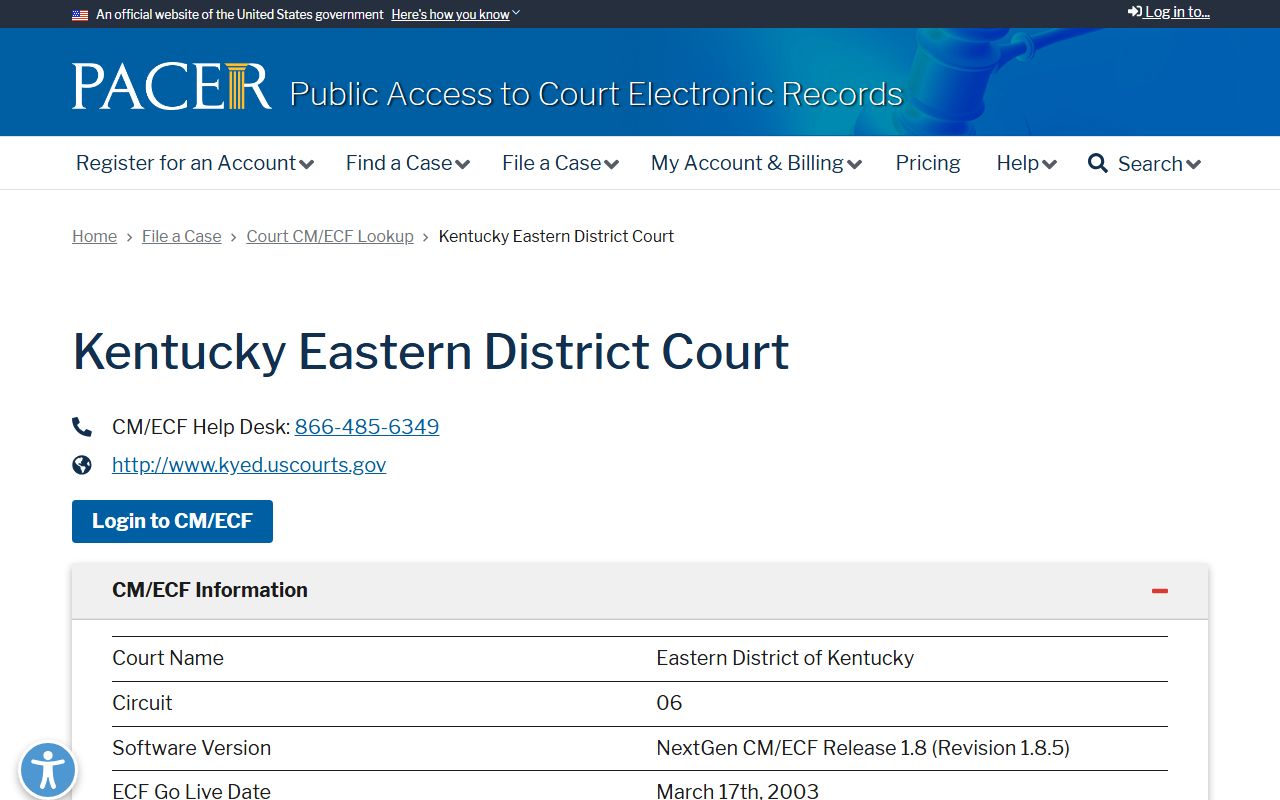
Use PACER for federal cases, and use Kentucky court systems for Floyd County state charges.
The third assigned image is the federal court locations source. The Eastern District of Kentucky court locations page helps identify federal venues separate from Floyd County state court.
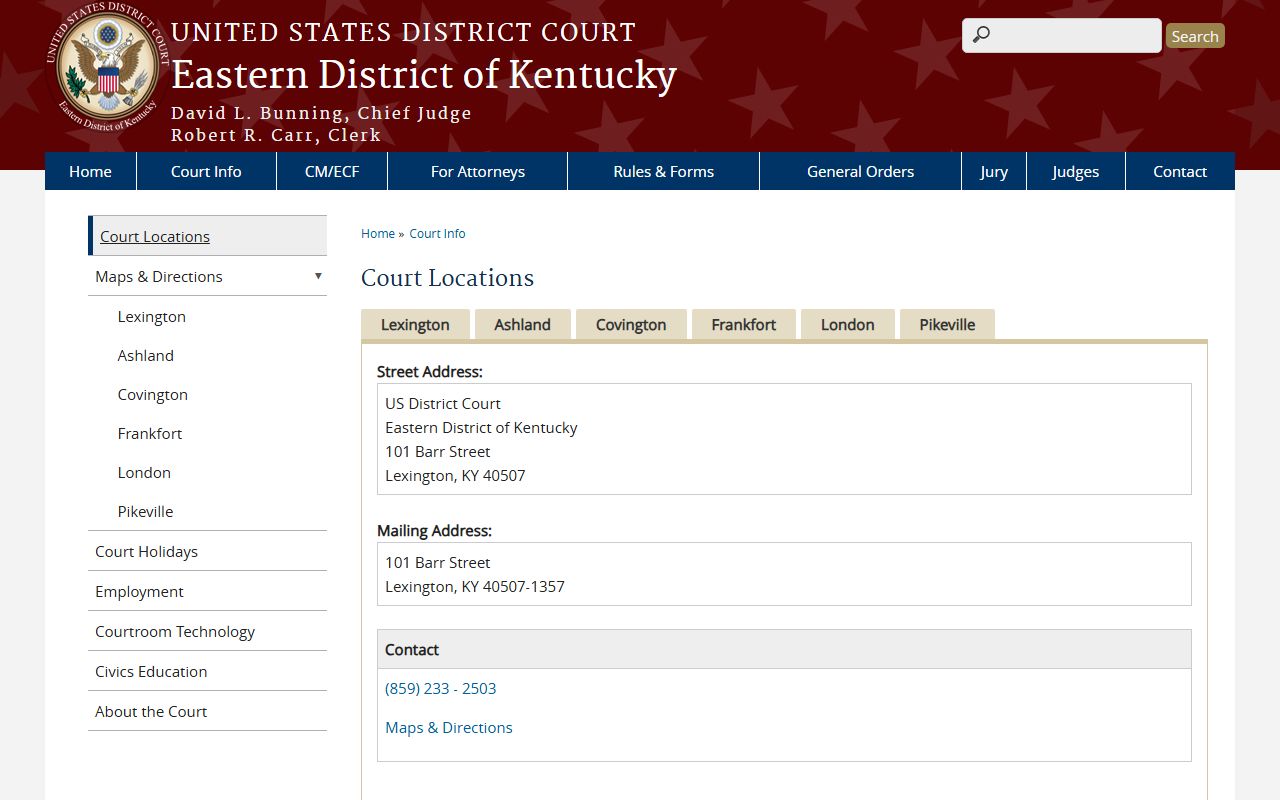
Federal case location does not change the state-court route for Floyd County charges filed in District or Circuit Court.
Sealed vs Expunged Arrest Records
Sealing and expungement can affect whether Floyd County arrest records or charge records appear in public searches. Juvenile court records are confidential under KRS 610.340. Expungement of convictions requires eligibility certification under KRS 431.079, and AOC's expungement-order index is restricted under KRS 431.074.
| Sealed | Expunged | |
|---|---|---|
| Public view | Hidden or limited by law or court order. | Removed from official public state background checks after order. |
| Arrest link | The public may not see some charge or case details. | The official public record should stop showing the expunged matter. |
| Index | May still exist for authorized access. | AOC retains a restricted index. |
| Private data | Old third-party pages may lag. | Private sites may remain stale even after official action. |
Restricted Floyd Charge Records
Not every arrest or charge detail is open. Active investigative material may be exempt under Kentucky public-record law. Juvenile records are confidential. Sealed and expunged matters may not appear in public systems. Family or protective-order records may redact protected addresses, minor information, medical details, and safety information. Mental-health commitment details are restricted due privacy interests.
For public defender questions, Kentucky uses the Department of Public Advocacy, and appointment depends on indigency and case type. For prosecutor questions, use the office listed on the court notice or ask the Floyd Circuit Court Clerk for the correct contact tied to the case. The research did not locate a current official Floyd Commonwealth's Attorney or DPA office page with a verified address and phone, so no unverified local prosecutor contact is published here.
Important: Arrest records and charge records are not consumer reports and should not be used for FCRA-regulated screening.